After all of the viruses, ear infections, and car problems (not to mention all the stress and worry over the CPSIA) over the past few weeks, it's been a rocky start to the year. But I'm thrilled that I now have some good news to share!
First there's this:
CPSC Grants One Year Stay of Testing and Certification Requirements for Certain Products
In plain English, that means that they will not be enforcing the lead testing and certification on products for children 12 & under for another year. So, I still have to make sure my products meet the lead limits, but I can do so by making sure that the supplies I use are lead-free, rather than have to have everything tested. Now I realize that this is by no means the end of this mess, but it is at least a step in the right direction. So I can continue to make these adorable baby shoes, at least for the time being:
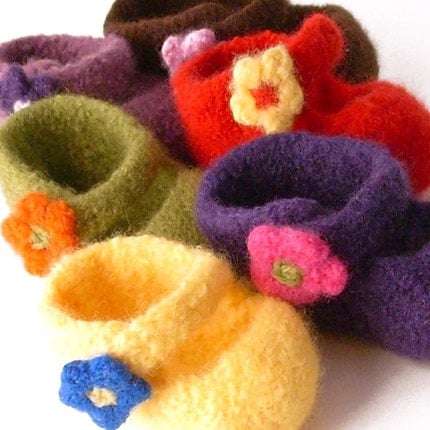 Even better CPSIA news, a senator from South Carolina is going to introduce legislation to make some changes to the CPSIA. Here's a link to his blog: Jim DeMint's BlogSo it seems that we are finally being heard, and steps are being taken to straighten this mess of a law out. Hurrah! Let's all make sure to keep up the good work on the CPSIA front...keep making those phone calls, sending those faxes and emails, and blogging!
Ok, now for some more unrelated good news:
As you know, I have a day job working at a florist. Each year the Maine Teleflora Unit (for those of you who don't know, Teleflora is a network of florists that enables you to send flowers world wide) awards a scholarship to one lucky person to take a class at their headquarters in Oaklahoma City, all expenses paid. Well, I just found out that I am this year's scholarship winner! Wow!!
So sometime this year I will being heading to Oaklahoma City to take a floral design class for free, and my whole trip is paid for...plane tickets, hotel room, food, everything! How cool is that?? Now I just have to decide which class I want to take. One of my top choices would be the Wedding Design class, as weddings are my favorite occasion to design flowers for (which reminds me...I have some pictures from a couple of Bridal shows that I need to get off my camera so I can share them here!). Another top contender is one called Creative Edge: East/West Fusion, which takes principles of Ikebana, the Japanese Art of Flowers, and adapts them for contemporary design. Hmm...decisions, decisions! In the meantime, here's some of my floral sushi for you:
 Floral Sushi, designed by Shannon Hanley
I sifted through the CPSIA FAQ on the CPSC site, and pulled a few of the questions that I thought would be most helpful for my fellow crafters, artisans, and Etsy shop owners to see. I hope this helps some of you make a little more sense of this incredibly vague and complicated law. Make sure to see my previous blog post for a list of links with more information.Lead Content and TestingDo all children's products require testing for lead or is it only products with some type of surface coating? We sell products that are used in physical education classes (e.g. hula-hoops) that are made from polyethylene and are not painted or coated. Will this product require third-party testing and certification for lead content under the new CPSIA? All children’s products (as defined by the CPSIA) subject to the lead limit of the Act will eventually require testing for lead, not just those with surface coatings. It is important to distinguish between the rules that apply to lead paint and surface coatings and the rules that apply to lead content. The CPSIA provides limits to the amount of lead in paint and surface coatings and limits to the amount of lead in the content of the product itself. Children’s products that are painted, or have surface coatings are also subject to the lead paint limit, in addition to the lead content limits.When do the lead content limits go into effect for children’s products? The lead content limits for all children’s products go into effect February 10, 2009 (600 ppm) and will be lowered again on August 14, 2009 (300 ppm).What certifications are required for children’s products that are tested for lead content? Children’s products manufactured after February 10, 2009, when the lead limit may not exceed 600 ppm, will need a general conformity certification based on a test of the product or a reasonable testing program for products after that date. Children’s products manufactured after August 14, 2009, when the lead limit may not exceed 300 ppm, will have to be certified based on third-party testing of the product by accredited third party laboratories after that date.Does the CPSIA envision stuffed animals falling within the scope of the CPSIA’s lead limits or phthalate limits? Most stuffed animals would be considered to be children’s products and presumably toys. A manufacturer would need to determine whether the design of the stuffed animals is such that it is subject to the lead paint limits, the lead content limits or the phthalate limits. Labeling of all children's productsThe law requires manufacturers to start labeling product and packaging one year after enactment. Does that mean it would affect products manufactured for the 2010 retail season or that items in retail stores would already have to have tracking labels as of August 2009? The law requires that one year after enactment, or August 14, 2009, manufacturers of children’s products must place permanent marks on their product providing the information specified. Thus, the Commission staff believes that the tracking label requirement applies to children’s products manufactured on or after August 14, 2009.What information needs to be provided on the product to meet the tracking label requirements of section 103? Does section 103 of the CPSIA require that a manufacturer’s name be present on a tracking label? Section 103 of the CPSIA provides that the tracking label must contain information that will enable the manufacturer to ascertain the location and date of production of the product and cohort information (including the batch, run number, or other identifying characteristic) and any other information determined by the manufacturer to facilitate ascertaining the specific source of the product by reference to those marks. Section 103 of the CPSIA further provides that the tracking label must contain information that will enable the ultimate purchaser to ascertain the manufacturer or private labeler, location and date of production of the product, and cohort information (including the batch, run number, or other identifying characteristic.) Thus, section 103 of the CPSIA does require that the tracking label contain information sufficient for the purchaser to ascertain the manufacturer of the product. Watch the Commission's website for postings regarding further guidance on this issue. The Commission will seek comments from the public during this process. Phthalates Limits and TestingWhat kind of products does the phthalates prohibition apply to? Three phthalates, DEHP, DBP, and BBP, have been permanently prohibited by Congress in concentration of more than 0.1% in “children’s toys” or “child care articles.” A “children’s toy” means a product intended for a child 12 years of age or younger for use when playing, and a “child care article” means a product that a child 3 and younger would use for sleeping, feeding, sucking or teething. Three additional phthalates, DINP, DIDP, and DnOP, have been prohibited pending further study and review by a group of outside experts and the Commission. This interim prohibition applies to child care articles or toys that can be placed in a child’s mouth or brought to the mouth and kept in the mouth so that it can be sucked or chewed that contains a concentration of more than 0.1% of the above phthalates.How do you determine whether a product is a child care article for purposes of compliance with the phthalates limits? A child care article is a consumer product designed or intended by the manufacturer to facilitate sleep or the feeding of children age 3 and younger, or to help such children with sucking or teething. By way of example, a pacifier/teether would be an item that would help a child with sucking or teething; a bib would facilitate feeding; a crib mattress would facilitate sleeping as would pajamas and crib sheets.Does the prohibition on phthalates apply to jewelry? It depends. If such jewelry is intended for use as a toy for a child 12 years of age or younger, the phthalates prohibition would apply. When does the phthalates ban go into effect for children’s toys and child care articles and does it apply to inventory in existence on February 10, 2009? On February 10, 2009, DEHP, DBP, and BBP are permanently banned, and DINP, DIDP, and DnOP are banned on an interim basis, for children’s toys or child care articles as defined in section 108 of the CPSIA. The ban on the six specified phthalates in section 108 of the CPSIA only applies to products that are manufactured on or after February 10, 2009. For more information see the Office of General Counsel Advisory Opinion (http://www.cpsc.gov/library/foia/advisory/320.pdf). What certifications are required for children’s toys and child care articles subject to the phthalates ban? Children’s toys and child care articles manufactured on or after February 10, 2009, will need a general conformity certification based on a “test of each product or a reasonable testing program.” Starting in September 2009, children’s toys and child care articles will have to be certified based on third-party testing of the product by accredited third-party laboratories. The Commission must post its procedures for accrediting labs to test for phthalates in June 2009.
The Consumer Product Safety Improvement Act of 2008, which was passed by US Congress in August imposes a ban on lead in all products intended for the use of children age 12 and under. While at first this sounds like a good idea, as we all want our children to be safe, it is a sweeping legislation that could effectively wipe out all small businesses and independent makers of children's toys, clothing, and accessories, and drive up the cost of the rest. The law states that all products, even those which by their nature do not contain lead, must be tested by a third party lab. These tests can be quite costly at up to $300 per test or more. Say you have an independent designer who makes several styles of dresses for girls. If each dress contains 3 different fabrics, thread, buttons, and a zipper, the tests could cost up to $1800 or more for just that one style. And each different style would have to be tested seperately, even if they use some of the same materials. Since many of the independent and small business don't have the funds available to afford such high-cost testing, we will be faced with two options:
1. Sell our products illegally.
2. Go out of business.
I would be devastated to see all the work I have put into not only my own business, but also into the EtsyKids Team over the past 2 years, just disappear because of this. And this won't just affect the small businesses and independent makers of children's products. Do you really think the large corporations will just absorb this new cost? Of course not...they will pass along this expense to you, the consumer, potentially sky-rocketing the cost of all products for kids. I am so overwhelmed and distraught over this, I can hardly think straight. Fortunately there are other people who have been able to put together some very eloquent writings on the subject, so I'm going to share the links with you here:
Blog posts:
http://www.gorgeousbaby.ca/blog/?p=79
http://mollyodesigns.blogspot.com/2008/12/write-to-your-representative.html
http://mamasmagic.blogspot.com/2008/12/do-you-love-handmade-have-kids-of-your.html
More info, and how you can help:
http://www.handmadetoyalliance.org/
http://www.ipetitions.com/petition/economicimpactsofCPSIA/index.html
http://nationalbankruptcyday.com/
http://en.wikipedia.org/wiki/Consumer_Protection_Safety_Improvement_Act\
http://www.coolmompicks.com/2008/12/save_handmade_toys_in_the_us.php
And here's a link to the law itself:
http://www.cpsc.gov/cpsia.pdf
 Floral Sushi, designed by Shannon Hanley
